
The Regenerative Practitioner Series
Hybrid Online/In-Person in Tāmaki Makaurau Auckland, Aotearoa New Zealand
No matter the industry, siloed ways of working are undermining our ability to truly impact the health of our places and communities. Regenerative practice is a way to work towards outcomes, effects and impacts that genuinely contribute to the holistic health of our project’s place–while simultaneously fulfilling our project’s potential.
Whether we’re designing a building, developing a new social service, creating an art work, managing a farming enterprise, or replanting a forest, each activity calls us to grow our capabilities and capacities to work with the complexity of whole living systems.
About the series
The Regenerative Practitioner Series has been evolved and refined over a decade of delivery to 50+ cohorts of practitioners hailing from over 40 countries. Graduates from across a broad diversity of geographies, cultures, and professional disciplines describe the series as an experience that is deeply transformative, and provides a new platform from which to bring regenerative thinking to your work, your collaborations, and your communities.
Over the course of the seven-month program, participants engage deeply with a methodology for regenerative development that has been developed and extensively field-tested by Regenesis over 30 years and hundreds of projects around the world.
Learn while doing: Work on your own live project (or project concept) as part of small study groups, receiving direct coaching from Regenesis faculty. Join in on large-group dialogue sessions with other study groups from across Aotearoa New Zealand and learn from the cross-pollination of different industry and place perspectives.
Learn globally: From Regenesis Institute faculty–world leaders in regenerative development who have field tested their approach for over 30 years in hundreds of projects around the world.
Learn locally: Experience kinaki (supplementary) learning resources alongside the core curriculum that bring forward Te Ao Māori perspectives on regeneration.
Inner & Outer Work
There is rapidly increasing consensus around the imperative need to bring our human communities back into life-giving alignment with the ecological systems that nourish us. This requires outer development: projects, initiatives, infrastructure and systems change.
The Regenerative Practitioner Series is based on the premise that the critical foundation for this outer development is the inner development of new levels of capacity, consciousness, cultural identity and will, both in ourselves as practitioners and in the communities and systems we work within.
Core to the process of developing a regenerative practice is growing the capacity to work simultaneously on these inner and outer dimensions.
Our understanding of what’s required of ourselves as practitioners and as human beings deepens as this inner work unfolds. For this reason, we do not think of the series as a “training” but rather as a deep dive into a new way of seeing and thinking about our work that provides a new foundation from which to chart one’s own unique developmental path.
Image: ‘Abundance Basket’ sculpture – Caroline Robinson
“Deepening my understanding and application of regenerative thinking has profoundly shaped both my personal and professional life. It offers practical tools and ways of thinking that help me navigate complexity and constraints, and show up with greater intention and purpose.”
Sara Zwart
Manager, Regeneration | Blue Green Networks, Te Tari o Ngā Waiora | Healthy Waters
Te Kaunihera o Tāmaki Makaurau | Auckland Council

How does the series work?
The Regenerative Practitioner Series is an in-depth, six-month course held over Zoom. The course includes ten two-hour dialogue sessions structured around our curriculum of reading material and practice exercises, and culminates in a three-day intensive workshop.
How does the series work?
- Sessions are two hours in length, held every other week. For each session, participants will complete a preparatory reading and assignment.
- The sessions themselves combine live instruction with open group dialogue and one-on-one “fishbowl” time, where a single participant works with our instructors to explore a project they are actually working on as a way of bringing strategic frameworks to life for the entire group.
- The sessions are recorded and made available for download, so you can catch up if you miss a session. Participants typically spend between 3 – 5 hours per week preparing for and engaging in the sessions and course assignments while this portion of the course is underway.
- In the off weeks between sessions, you will be encouraged to meet with one another in small study groups to work on grounding the content of the sessions through real-life application and a group assignment.
- Each study cohort receives 4 hours of faculty coaching over the duration of the series.
- Depending on your cohort selection, your Intensive may be held either online or in person.
- The Intensive takes place over a long weekend, with sessions lasting all day with a lunch break on Friday – Sunday.
- The Intensive combines dialogue in large and small groups with journaling and reflection exercises.
- The Intensive is followed by a final two-hour zoom session, held approximately two weeks after the weekend workshop.

Is this course right for me?
We encourage all prospective TRP participants to engage in your own process of self-identifying as a regenerative practitioner. To support you in that, we’ve developed a list of qualities that can help you assess whether the course would be a good fit for you.
Is this course right for me?
We encourage all prospective TRP participants to engage in your own process of self-identifying as a regenerative practitioner. To support you in that, we’ve developed a list of qualities that regenerative practitioners tend to share, which can help you see whether the course would be a good fit.
To help with this, you might ask yourself whether some or all of these statements apply to you:
- You often see bigger potential than is being realized on the projects you’re involved in but haven’t found a way to help your collaborators and/or clients see and align with that potential.
- You know that sustainability will never accomplish its aims if we can’t change the way we think and work, but you’re not sure how to achieve this.
- Your work is important and meaningful to you, but you still feel the drive to learn and develop along a path so that your work and the essence of “who you are” become further and further integrated.
- You have a track record of delivering results, and yet you continually see possibilities beyond the level that you are currently able to realize.
- You feel a strong desire to be part of a larger community of likeminded practitioners mutually committed to growing and deepening the impact of your work.
If so, you may be a good candidate for the series. If you are considering enrolling in TRP but unsure as to whether the course is right for you, you may request a conversation with a faculty member to mutually assess whether it’s a fit.
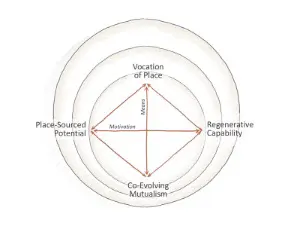
What material is covered?
The series is structured around a systemic framework that has been developed and tested over decades of working in communities around the world. The framework integrates four core elements that enable regenerative thinking and working across nested systems.
What material does the series cover?
The series is structured around a systemic framework that has been drawn from and tested through decades of working on regenerative development projects in communities all over the world. The framework integrates four core elements that enable regenerative thinking and working across the nested systems in which we work.
The learning outcomes of the series are as follows:
- A deeper understanding and embodiment of regenerative development principles and how they unfold both in your personal life and in projects and communities
- Greater ability to assess project design and development practices for their regenerative potential
- Greater ability to define how a regenerative approach would apply to various sectors and fields of practice relevant to your work
- Increased capacity to manage complexity as a means to deliver greater value to clients and stakeholders
- A new grounding into the significance of place as a coalescing force for regenerative work, yielding fresh insights and observations into the places in which you live and work.
- New insight into the contribution that your practice can make to the systems in which you work, and the ability to chart your own developmental path towards realizing that contribution
- The support of a growing learning community of peers and colleagues who share your commitment to creating profoundly innovative work in service to a healthier community and world.
- New insights into and discernment around how to grow increasing levels of caring, motivation and spirit in our teams and our projects.
For more information about the content covered in the series, you may download the course syllabus.
In-person Intensive in Tāmaki Makaurau
The series concludes with an in-person intensive in Tāmaki Makaurau Auckland. You are responsibility for covering your personal travel costs to, from and around Tāmaki Makaurau Auckland as well as accommodation throughout. Billeting options for koha are available (with graduates of the series).
In-Person Intensive, March 11th – 14th, 2027:
- Thursday 11th, 6pm – 8pm: Welcome and orientation. Dinner provided.
- Friday 12th, 9am – 5pm: Sessions run from 9-5pm with breaks and ample lunch time. Lunch provided.
- Saturday 13th, 9am – 5pm: Sessions run from 9-5pm with breaks and ample lunch time. Lunch provided.
- Sunday 14th, 9am – 5pm: Sessions run from 9-4pm with breaks and ample lunch time. Lunch provided. Participants depart early evening.
We are continuing to both tend existing and build new relationships with Mana Whenua of Tāmaki Makaurau Auckland to discover how the delivery of this course can happen in a way that is tika, aligned with iwi aspirations and attuned to the potential of place. As such, some logistical details about the Intensive are not yet confirmed.
Course Tuition & Scholarships/Subsidies
Tuition for the Series varies by cohort location. We offer a variety of strategies to create tuition accessibility.
Sliding Scale Tuition
In Aotearoa New Zealand, tuition is available on a sliding scale basis; we invite applicants to self-select whether they are able to pay the full tuition.
Our full tuition is $4,500 NZD per person. Please note, you will be responsible for covering the costs of your personal travel expenses and accommodation for the 3 day in-person Intensive (billeting options and financial support is available for this if needed).
A 25% discount off the full tuition is available for self-funders (i.e. those not funded by their organisation).
For the 2026/27 series only, a 50% discount off the full tuition is available for “place-focused” or “field-focused” groups of 4-6 people who sign up together, for example:
- A project team
- A group of collaborators all working on projects within a specific place
- A group of professionals in the same field, working in a similar role across multiple organisations
For practitioners who require more than a 50% discount to enable their participation, limited additional scholarship support is available. These are prioritised for practitioners who align with our equity priorities (see below) and will be considered on a case-by-case basis.
We encourage you to select the standard tuition rate if your organisation is funding your participation, and/or you have an established and successful practice, in economic conditions that make this a viable investment.
We also offer the option to pay tuition via a six month payment plan (see the Payment Plans section below). We encourage you to reach out if you have further questions about our sliding scale tuition or scholarship program.
Additional Equity-Based Scholarships/Subsidies
If our sliding scale discounts are not sufficient to enable your participation, we encourage you to make a request for additional scholarship/subsidy funds.
To apply, fill out the enrollment form and indicate that you require additional funds; this will prompt you with additional questions to complete your scholarship/subsidy request. We approve scholarships/subsidies on a rolling basis, so we strongly encourage applicants who know they would require such support to apply as early as possible in the enrollment period. Please note, if you are requesting a scholarship, you will not complete the process of paying your course tuition until your request is reviewed and approved.
We place a special emphasis on using scholarship/subsidy funds to create equity of access to this work and inclusivity within our “community of communities”, as based on alignment with our equity priorities:
- Practitioners who work as community activists and/or organizers serving marginalised populations and/or underfunded communities.
- Practitioners from under-represented backgrounds, including Indigenous practitioners and practitioners of colour.
- Practitioners from countries with low economic purchasing power relative to the US (including countries in Africa and Latin America).
- Practitioners who are coming from a lack of financial stability or security, including those whose financial stability has been affected by current global economic conditions.
Please note that scholarships/subsidies take the form of a reduction in your tuition costs. You will still be responsible for your personal travel expenses for attending the three and a half day day in-person intensive at the end of the series in Tāmaki Makaurau Auckland, however billeting options are available (with graduates of the series).
Payment Plans
Six-month payment plans are available. To enroll in the Series, you may either pay the full tuition amount, or pay the first of the six monthly payments. Payment plans include administrative fees.
Withdrawals and Refunds
If circumstances intervene and you are no longer able to participate after having registered, we are able to offer a full refund of your tuition and/or deposit up until the enrollment deadline. If you need to withdraw after that point, we will retain any deposit/tuition paid as a credit-on-file should you want to participate in a future cohort.
Course Schedule
As well as committing to each fortnightly two hour zoom session, each study group is encouraged to meet for two hours between sessions to complete assignments together. It is also recommended that 2-3 hours of reading time is set aside for engaging with course readings before each session.
Kinaki resources are available throughout the series in a variety of different modalities, including audio recordings, video, learning kits and more. Participants are invited to engage with these at any time to supplement their learnings.
| Session | Date | Time (NZ) | Local Session Calculator |
| Meet-up | Friday 9th October | 9-11am | Calculate your local session time |
| Session 1 | Friday 23rd October | 9-11am | Calculate your local session time |
| Session 2 | Friday 6th November | 9-11am | Calculate your local session time |
| Session 3 | Friday 19th November | 9-11am | Calculate your local session time |
| Session 4 | Friday 4th December | 9-11am | Calculate your local session time |
| Session 5 | Friday 15th January | 9-11am | Calculate your local session time |
| Session 6 | Friday 29th January | 9-11am | Calculate your local session time |
| Session 7 | Friday 12th February | 9-11am | Calculate your local session time |
Session 8 | Friday 26th February | 9-11am | Calculate your local session time |
| In-person Intensive | Thursday 11th – Sunday 14th March | Evening Thursday, All Day Friday & Saturday, until Evening Sunday | — |
| Session 9 | Friday 2nd April | 9-11am | Calculate your local session time |
| Kinaki Sessions | Available throughout | online access |
Faculty
The Regenerative Practitioner Series Aotearoa is delivered by Aotearoa-based Regenesis faculty member Lucy-Mary Mulholland and Regenesis global faculty member Nicholas Mang, alongside local hosts Amanda Hookam and Rachel Ruckstuhl-Mann.
This series has always been held by a bi-cultural host team working to live into Te Tiriti O Waitanga through the delivery of the course. This host team partnership began in 2016 between founding Aotearoa host team members Caroline Robinson and Lucy Tukua (Ngāti Paoa, Ngāti Whanaunga, Ngāti Karewa), with additional support by Jerome Partington. More recently, Regenesis has collaborated with Johnnie Freeland (Ngāti Te Ata Waiohui, Ngāi Tūhoe), whose concept of binocular vision continues to influence the way the course has evolved in Aotearoa and across the globe.
We are currently in a process of mapping the whakapapa (lineage) of this form of regenerative practice, to make publicly available. If you’d like to know more about this story please reach out – lucymary@regenerat.es.
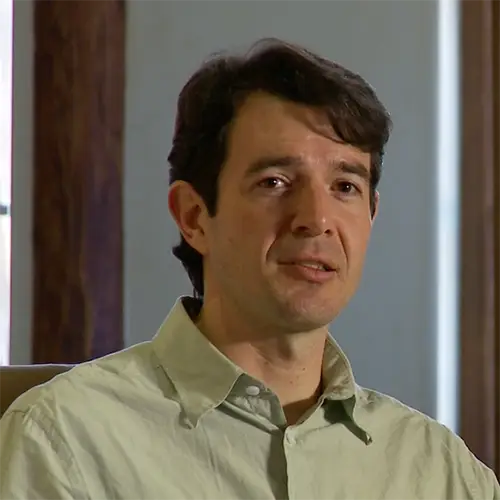
Nicholas Mang
Core Faculty | Ojai, California, United States
Nicholas Mang is a principal at Regenesis Group and core faculty member at Regenesis Institute, where he has co-developed and taught developmental education programs for practitioners around the world. As a practitioner, Nicholas’s work has its roots is in community planning and organizing with a focus on urban regeneration work, developing leveraged intervention processes for reigniting community involvement in the stewardship of place.
Nicholas’s educational background includes masters and doctoral level work in cross-cultural studies, living systems thinking, social transformation theory, eco-psychology (the bridge between psyche and ecological place), and spiritual psychology.
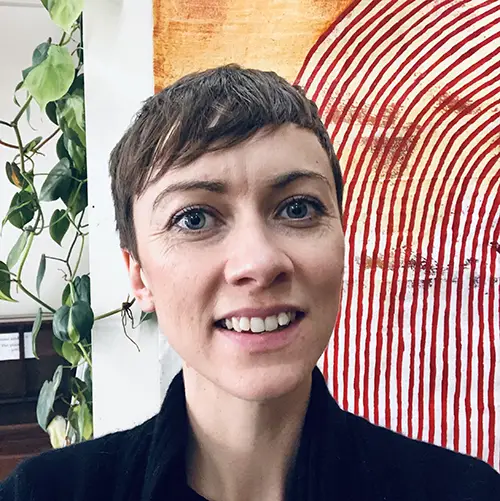
Lucy-Mary Mulholland
Faculty | Christchurch, Aotearoa New Zealand
Lucy-Mary is nested within the Ōpawaho Heathcote river catchment, known as South Christchurch (South Island, Aotearoa/New Zealand), where she lives with her partner Michael. She acknowledges the kaitiaki (indigenous custodians of this land) Ngāi Tahu, Ngāti Māmoe, and Waitaha. Previously a child and adolescent therapist, she now works as a developmental facilitator, supporting turning-point moments for community groups and organisations aspiring to create regenerative impact. She has worked with the likes of Greenpeace, Callaghan Innovation, For The Love of Bees, South Titirangi Neighbourhood Network, Upper Harbour Ecology Network, Earthsong Eco-Neighbourhood, and many others. She is also faculty and local host for Aotearoa cohorts of The Regenerative Practitioner Series. She continues to draw on her therapeutic skills, arts background, Celtic ancestry, and the mentorship of the late Caroline Robinson (regenerative pioneer in Aotearoa) to create meaningful co-creation towards co-evolution and oranga (wellbeing).
Ready to start your deep dive into regenerative practice? Start your enrollment for the Series by clicking the button below.
Need to connect with us to discuss joining our programming?
If you need a conversation with a member of our community to better evaluate if The Regenerative Practitioner Series is the right fit for you, we welcome the opportunity to connect you with a member of our staff, faculty, or local host team community.
Want to get a taste of our approach to regenerative development and learn more about our global co-learning community? Watch recordings of recent public seminars on our Seminars page.
Photo credit: Ofrenda at Austin TRP Intensive, Elkk Photography.
